Merging GTAO and a Fast SSAO Technique
Bachelor's thesis on screen-space ambient and directional occlusion, two SSAO techniques merged in compute shaders to get the best of both.
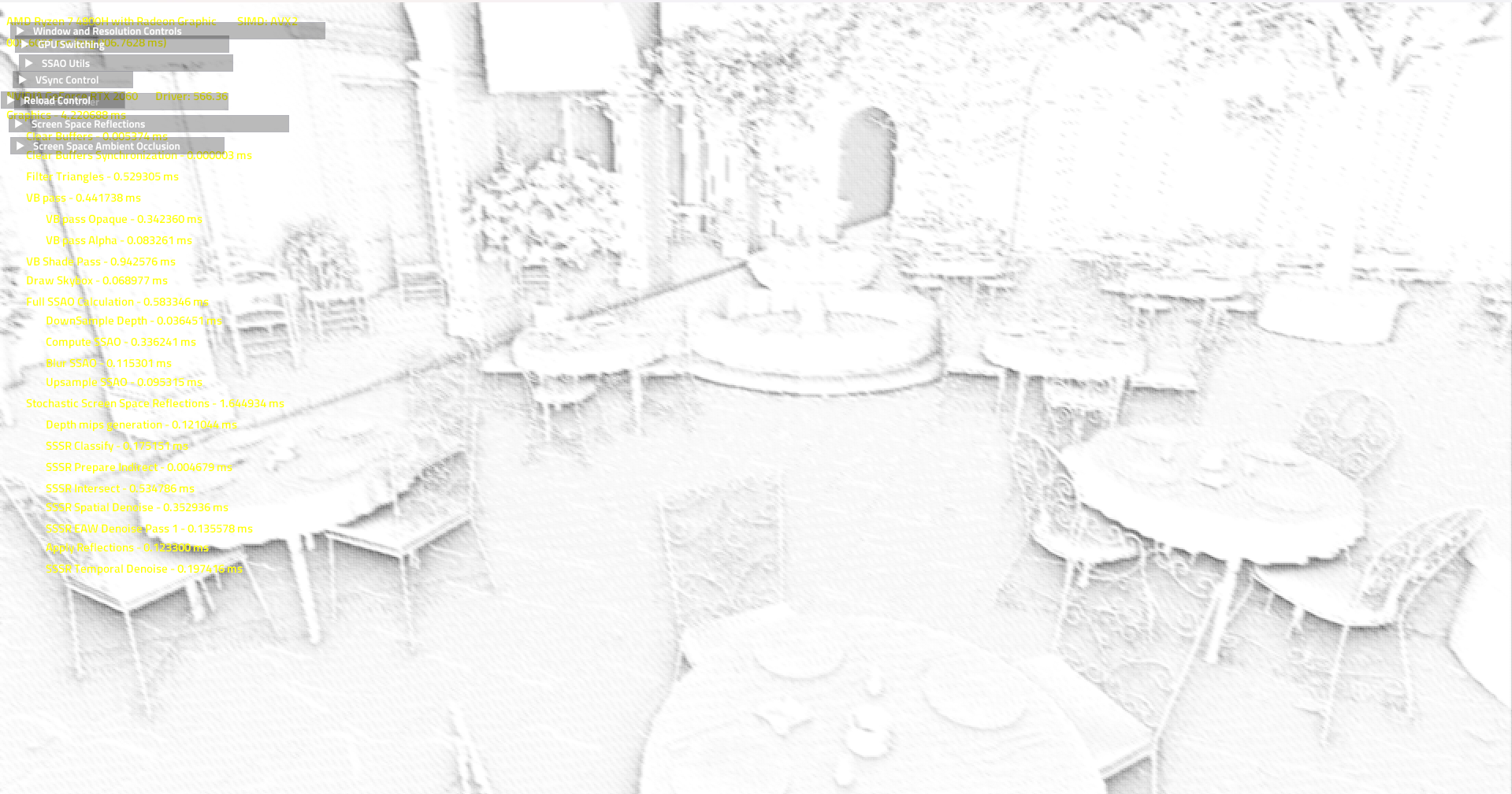
For my Bachelor’s thesis I studied Screen Space Ambient and Directional Occlusion. In the end I decided to merge two SSAO techniques and use compute shaders to get the best of both worlds.
Framework
I decided to learn a framework that is being used in the industry for this research. It is called The Forge.
The Forge is a low-level, multi-platform rendering framework designed to serve as a robust rendering system for game engines. It supports a wide range of platforms, and has built-in support for timing rendering passes and shader code. It also exports a nice graph of all timings and render passes with each launch of your application. That’s why I chose to learn this framework.
Fast SSAO
The first technique I decided to use was a fast SSAO technique by Wojciech Sterna, described in GPU Zen.
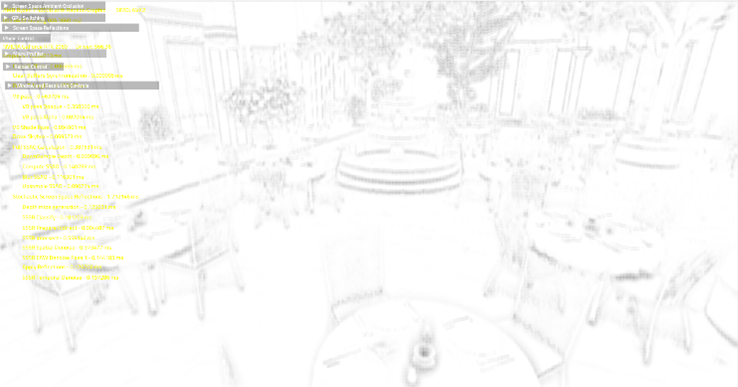
This technique took about 0.40 ms.
Ground Truth Ambient Occlusion
This is my implementation of Ground Truth Ambient Occlusion, described in a paper from Activision.
This technique took about 1.6 ms.
The merged technique
I combined the optimizations of the fast technique with the SSAO calculations of GTAO. In my opinion, the result is a genuinely good tradeoff between visuals and speed.
This technique took about 0.54 ms.
Paper
If you would like to read about this in more detail, I have written a paper going into it further: Merging SSAO Techniques (PDF).