Software Raytracer
A multithreaded CPU raytracer, pixels rendered in parallel with std::execution, accelerated with a per-triangle bounding volume hierarchy, Cook-Torrance materials.
$ git clone https://github.com/XanderBert/Software-RayTracer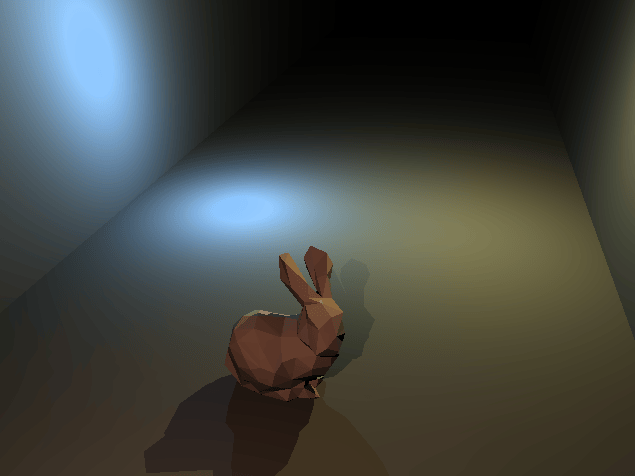
For the Graphics Programming I course, I built a simple multithreaded software raytracer.
Multithreading
The multithreading is fairly straightforward and simple. I have a function called RenderPixel(). That function gets called in parallel using std::execution.
std::for_each(std::execution::par, m_PixelIndices.begin(), m_PixelIndices.end(), [&](const glm::vec2& rayLocation)
{
    RenderPixel(pScene, rayLocation);
});
Bounding volume hierarchy
Another significant optimization was implementing Bounding Volume Hierarchies (BVH).
First we calculate bounding box volumes, per triangle rather than per mesh. I create a node for each triangle, and then the tree gets subdivided.
When we start tracing rays, we can do simple and fast AABB tests. When we get a hit, we go deeper into the tree, and we keep doing this until we reach a leaf node (the end of the tree). At that point we know our triangle is somewhere in that box.
This way, the number of intersection checks we actually need to do for our rays is reduced by a huge amount.
Materials
A few types of materials are supported in this raytracer:
- Solid coloring
- Lambert
- Lambert Phong
- Cook-Torrance
For the Cook-Torrance BRDF implementation we work with:
- Fresnel-Schlick
- Normal-GGX
- Smith
.OBJ loading
It’s capable of loading .obj files and showing them at runtime.